
Electronics & High-Tech
- Designed for electronics supply chains operating on fixed delivery windows
- Additional controls for sensitive, high-value and battery-powered devices
- Flexible routing through DXB, DWC and AUH global cargo gateways
- Scheduled and charter solutions for urgent replenishment and product launches

Why Electronics Supply Chains Use Air Freight
| Industry Challenge | Operational Outcome |
|---|---|
| Short product life cycles | Predictable transit schedules |
| High cargo value | Controlled handling procedures |
| Sensitive components | Reduced transfer exposure |
| Tight launch deadlines | Access to scheduled and charter capacity |
Air Freight for Electronics & High-Tech
Technology supply chains operate under strict delivery schedules, inventory targets and product launch deadlines. Delays can affect manufacturing continuity, distribution commitments and customer availability. For this reason, air freight remains one of the preferred transportation solutions for electronics and high-tech cargo moving between global production centres and end markets.
AC Global Services supports electronics shipments through UAE gateways, combining scheduled airline services, charter solutions and operational control procedures tailored to technology cargo.
Cargo Profile & Risk Factors
The electronics sector covers a broad range of products with different transportation requirements.
Typical cargo includes:


Common transportation risks include:
- Shock and vibration exposure
- Moisture and humidity
- Electrostatic discharge (ESD)
- Theft risk associated with high-value cargo
- Incorrect handling during transfers
- Lithium battery regulatory requirements
Cargo preparation should be aligned with product specifications and airline acceptance criteria.
Handling & Compliance Requirements
Electronics cargo often requires additional operational controls throughout the transportation process.
Where required, handling procedures can be aligned with customer-specific logistics protocols.
Recommended procedures may include:
- SOP-based cargo handling
- Tamper-evident packaging solutions
- Photo documentation during cargo acceptance
- Secure warehouse storage
- Piece-count verification
- On-request ramp supervision
- Lithium battery document review
- Export and import documentation checks
Why UAE Hubs Work for Electronics Logistics
Dubai and Abu Dhabi have become major transit points for technology cargo moving between Asia, Europe, Africa and North America.
Key UAE gateways include:
- Dubai World Central (DWC) – freighter and charter operations
- Dubai International (DXB) – extensive global airline connectivity
- Abu Dhabi (AUH) – additional cargo capacity and routing flexibility
Common onward destinations include:
- Frankfurt (FRA)
- Cologne (CGN)
- Leipzig (LEJ)
- Brussels (BRU)
- Liège (LGG)
- Amsterdam (AMS)
- Paris (CDG)
This network allows electronics shipments to move through a single transit region while maintaining access to multiple destination markets.
Recommended Services for Electronics Cargo
Service selection depends on shipment value, urgency and cargo profile.
Frequently used solutions include:

Different service combinations can be applied depending on inventory requirements and delivery targets.
Aircraft, ULDs & Cargo Planning
Technology cargo may move on both scheduled and dedicated freighter aircraft.
Common aircraft options include:
- Boeing 777 Freighter (B777F)
- Boeing 747 Freighter (B747F)
- Airbus A330 Freighter (A330F)
Depending on airline requirements, cargo may be built on:
- PMC pallets
- PAG pallets
- Compatible ULD containers
Special attention is typically given to packaging integrity, cargo stability and shock-sensitive equipment.
Performance & Operational Control
Electronics manufacturers and distributors often require shipment visibility throughout the transportation process.
Operational control options may include:
Performance targets depend on route structure, airline schedules and customs requirements.
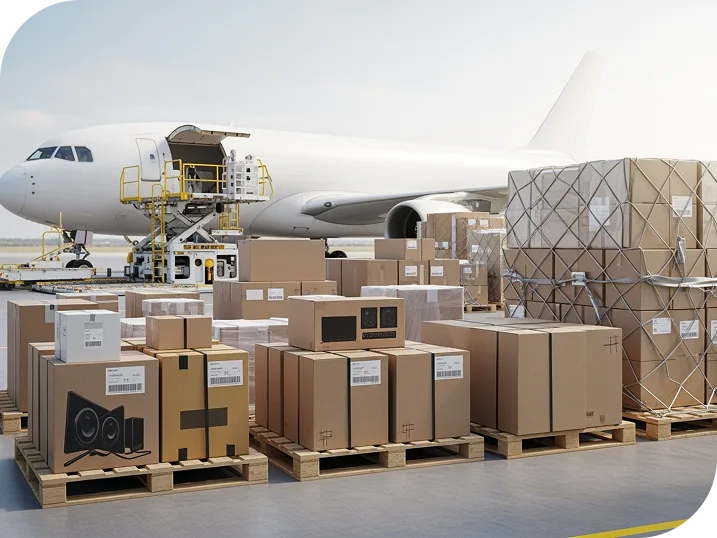
Industry Example
A technology distributor required transportation of networking equipment from Southeast Asia to Germany ahead of a scheduled infrastructure deployment.
The shipment was routed through DWC with controlled transfer handling and onward uplift to Frankfurt (FRA).
- Cargo Weight: 14,500 kg
- Transit Time: 72 hours
- Cargo Value: USD 4.2 million
The shipment was delivered within the planned deployment window without handling exceptions.

FAQ
Acceptance depends on battery type, packaging standards, state-of-charge requirements and applicable airline regulations.
Options may include secure storage, photo reporting, piece-count verification and supervised handling procedures.
Yes. Air transport is commonly used when inventory must reach distribution centres within defined launch schedules.
Depending on cargo compatibility and security requirements, consolidation solutions may be available.
Anti-static protection, internal cushioning and tamper-evident packaging are commonly used for technology cargo.
Charter solutions are typically selected for urgent replenishment cargo, large-volume movements or shipments with fixed delivery deadlines.
Contacts